An interview with Alan Sims, a Taijiquan practitioner from New York, about improvisational movement with purpose, single-footed balance and spinning — and what dancers can take from it.
Alan Sims has practiced Taijiquan for more than four decades, studying the Yang, Chen and Hao/Wu family styles in the lineage of the late master Jou, Tsung-Hwa. He has written many articles for martial arts magazines, including Budo International, and calls his own approach "The Dao of Movement" — pure self-expression through improvisational movement with purpose. Alan describes it as "ice skating on dry land".
We asked him what dancers can learn from it.
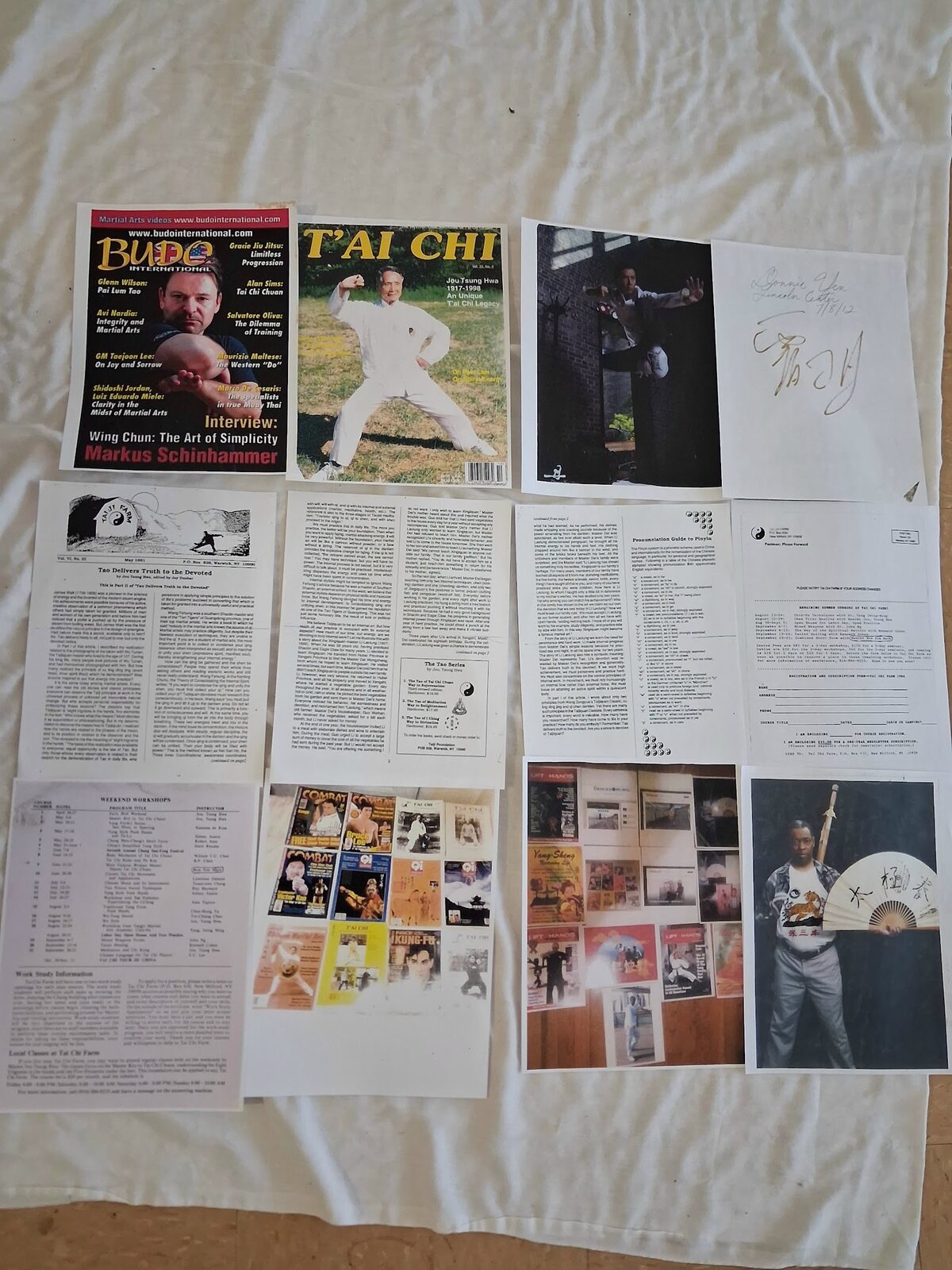
"The Dao Of Movement" to a large extent, is not something necessarily related to the practice of Taijiquan. It started as an idea or desire to deal with all types of adversaries, in different styles of martial arts. To always feel comfortable no matter what. Later the idea of just superior movement period, which can be used in sports, fighting, and probably dance as well came to me. "The Dao Of Movement" is not Taijiquan the way that I see it. Taijiquan can be looked upon as a highly advanced alphabet, stances and individual movements as words, and pure self-expression through improvisational movement with purpose as speaking. My achievement is the direct result of my 4 plus decades practice of Taijiquan which in my case produced higher and higher aims.
Taiji forms (sets, routines) ARE choreographed if we want to be real. All Taiji forms are based on single footed balance, probably to an unparalleled degree of any of the arts, sports, etc. based upon movement. In terms of spinning in particular, probably the Chen family's Taijiquan 1st and 2nd routines will offer the best training. Moving freely beyond memorized steps is something that might be an individual thing. In my case, I executed various complete movements (such as from "Crane Spreads Wings" to "Brush Knee") ON BOTH SIDES. My aim was to use different stances and the complete follow through of that stance. Let's say the stance preceding "Deflect Parry and Punch" into and through the complete movement ending with the punch. Apparently it worked!
Maybe I shouldn't say that they never leap backwards, as martial artists sometimes leap/jump backwards in retreat, but I haven't seen attacks starting directly backwards. I have done this only with traditional moves from the Chen 1st and second routines, which usually go to the left or right directions. It was an interesting idea that occurred to me right before practice one day and I didn't remember having seen it done before. It's not just jumping or leaping backwards, but with a technique.
I don't think that a simple exercise will capture the feeling of formless movement. You want formless movement, but what you don't want is ridiculous antics. The Dao Of Taijiquan by Jou, Tsung-Hwa is a great book to get. In it are the traditional forms of the Yang, Chen, and Hao/Wu family's Taijiquan. You can perform diverse stances which demonstrate various techniques using both (left and right) sides. The forms in general only use one side.
It was Larry Banks who convinced me of the necessity of moving through all types of stances. Although I must say that the method of doing so was purely an experiment of mine.
Master Jou, Tsung-Hwa was a super-fanatic when it came to Taijiquan. We who studied with him, were fanatics ourselves but we didn't know it! I personally think that master Jou (with his 110 acre Taiji Farm, 3 excellent books in English, Taiji Farm newsletters, and Chang San Feng festival) did more than anyone for the art of "Shadow Boxing" during his time.

I would like to thank James Eaton jr., my first martial arts teacher, The Sri Chinmoy Centre (where I met Larry Banks), Larry Banks (my original Taijiquan instructor), Bob Arietta (who taught me master Jou, Tsung-Hwa's updated forms), the late Marsha Rosa/Nolan, the late Abdul Musawwir, and H.Holiness Sant Rajinder Singh Ji Maharaj and his entire family and The Science Of Spirituality, and of course GoDance Support, and a special Happy Birthday to my cousin William Gamble of Atlanta Georgia!
Read more from Alan: Alan Sims: Exploring the Dao of Movement (The Sports Manual).
Contact Alan Sims: mr.alansims@gmail.com
The GoDance team crafts articles about dance, technique and inspiring stories from dancers.
Subscribe to our newsletter and get new content delivered to your inbox


